Winter Wine Club 2024
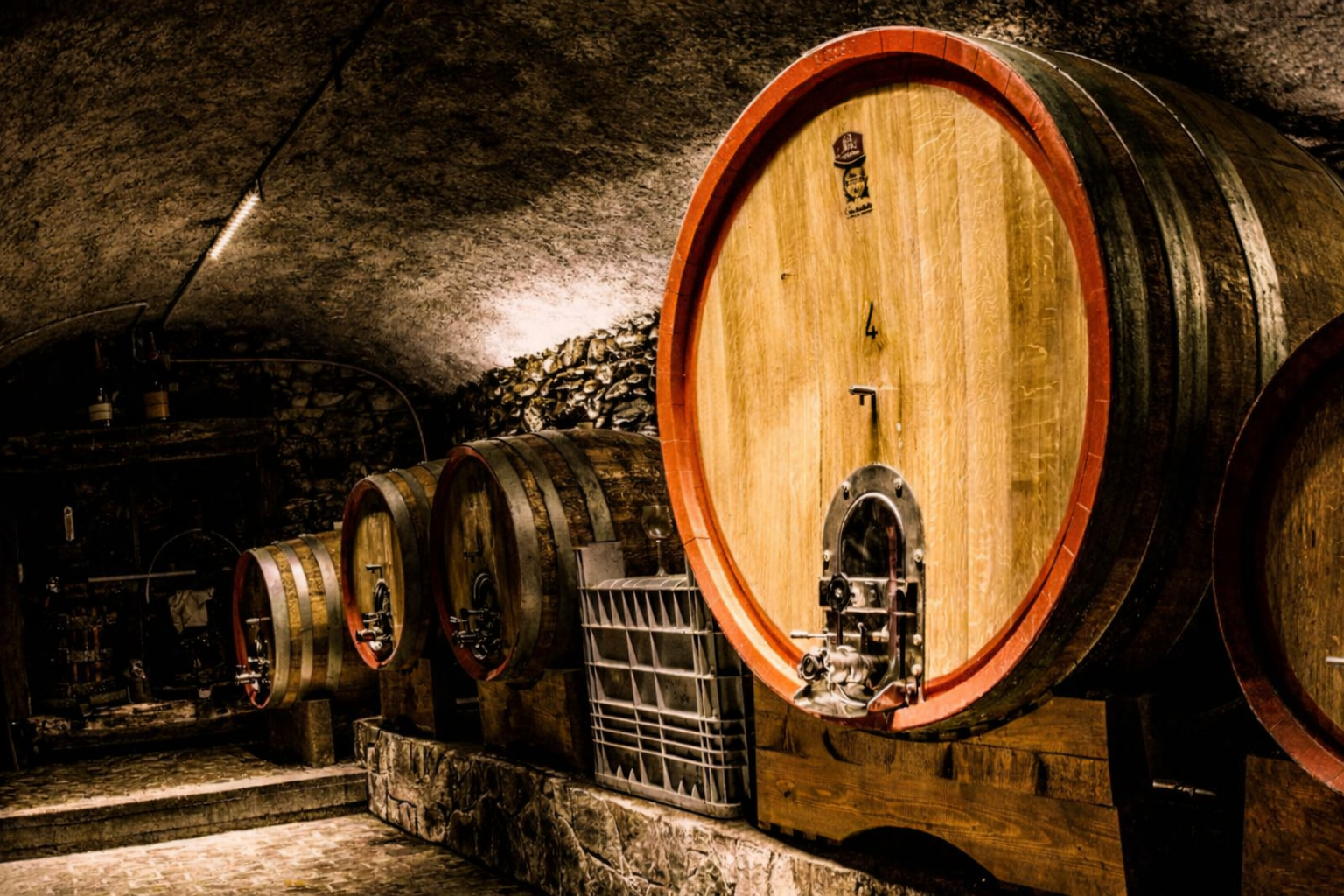
Imagine, for a moment, that you are a freshly made wine. (Pick a wine!) At this point in your life, you're a bit rough around the edges, somewhat surly, amorphous, and exhausted from all of the change you just went through. In a little over a hundred days, you just went from a leafy bud on a grape vine to fermented juice from ripe fruit. Luckily for you it’s time to rest, age, and mature. This aging in various vessels is mandatory while the last little bits of sugar are fermented out and malic acid is converted to lactic acid, adding softness, roundness, and complexity.
What kind of wine did you choose to be? If you chose rosé or white, your rest will be short and sweet; your journey is not typically one of patience, with flavors best enjoyed fresh; you need to be rushed along to eagerly awaiting consumers. If you chose a big structured red, you require a bit more time. It can take a while for tannins to integrate and smoothen out enough to feel balanced. Some appellations require multiple years of aging to be labeled with their name. Are you a Champagne? You get even more time to rest - adding time in the bottle after aging in larger vessels (barrel or tank.) This incorporates the character of the yeast that added your bubbly personality, adding flavors like wet rocks and brioche.
Aging is a fundamental part of winemaking, and how the winemaker chooses to do it is a crucial part of a wine’s final character. Porous vessels like oak and concrete allow small amounts of oxygen in, softening the wine. Most oak vessels are used multiple times, not imparting any flavor after the first tuse. Steel or glass tanks keep flavors razor sharp and focused. A winemaker must choose a wine’s path before grapes even enter the winery by selecting what it will be made with. With a few exceptions, oak aging speaks to me most because it allows the wine the most freedom in its evolution, while steel seems to trap a wine in its youth. With the hectic holiday season upon us, I hope your wines this winter can be enjoyed in moments of respite, rest, and rejuvenation. We could all use some, after all!
Parigot & Richard – La Sentinelle
.png)
Founded in 1907 & now in their 5th generation, Parigot & Richard craft Champagne-quality bubbles from nearby regions for a fraction of the cost. Composed of 80% Chardonnay and 20% Aligoté sourced from high elevation vineyards in the Côte de Beaune, La Sentinelle is a Crémant de Bourgogne: a traditional-method sparkling wine made the same method, but with grapes grown in Burgundy outside of Champagne. Aligoté is “the other white grape” of Burgundy & makes distinctly citrus and mineral-driven wines often with notes of crushed oyster shells, but it’s not a grape you’ll ever see in Champagne.
Traditional, or Champanoise, method bubbles are fermented twice: once from grapes into still wine, then again in bottle after an addition of sugar and yeast, called liqueur de tirage, which creates the signature sparkle. After this addition, the bottles at Parigot are aged for 36 months (longer than most Champagne) and turned by hand to incorporate flavors from the yeast. These resulting bubbles are a handcrafted marvel that should knock your socks off. Bubble go well with fried food, so throw a “fried chicken and sparkling wine” NYE party with your friends. I did this last year and it was so fun!
Arnot Roberts – Sauvignon Blanc 2023
.png)
Started in 2001 with just a barrel of wine in their garage, childhood friends Duncan Arnot Meyers and Nathan Lee Roberts, both born and raised in Napa, have slowly grown into one of the best medium-sized wineries in California and possibly the country. Duncan’s father was a cooper, or barrel maker, and he initially followed in his dad’s footsteps. Nathan pursued winemaking at some renowned wineries in Napa and Sonoma.
They have contracts with some of the most remarkable vineyards in Northern CA and aim to make pure wines that honor their origin by capturing their unique sense of place through minimal intervention in the winery. Native yeast fermentations allow the ecosystem of each vineyard to shine through, yielding flavors specific to each site. Their Sauvignon Blanc comes from gnarled 40 year old vines of the Randle Hill vineyard, a rugged and remote site in Mendocino County’s Yorkville Highlands AVA. 1,100 feet elevation and proximity to the Pacific Ocean keep nighttime temperatures cool, helping the grapes retain their natural acidity which is crucial in crafting naturally-made wines that age gracefully. This is one for charcuterie and conversation – “This is GOOD, right??”
Radikon – Slatnik 2021
.png)
Located in Friuli on Italy’s border with Slovenia, there is a winery without any signage or tasting room, because if there were “they’d never get any work done.” Stanko Radikon, pictured at right, was a winemaker of superlative natural wines, an innovator, and a maverick, yet humble and devoted to the past. His monolithic orange wines made using lengthy macerations, aging, and delayed release drove their reintroduction to the mainstream.
He was also famous for not believing in standard 750mL bottles – too much wine for one person, not enough for two. So, he designed and had his own bottles and corks made (check my tip-top wine shelf for some of the ½ and 1-liter bottles of his design.) His son Saša, pictured at left, began working in the winery as a child and slowly convinced Stanko that they needed a wine that was released earlier, less expensive, and in a standard sized bottle to broaden their audience. This was the birth of the ‘S’ line, to which Slatnik belongs.
Stanko passed in 2016, and Saša carries Radikon the exact same way Stanko’s father did before him since the 1930’s. Slatnik, named for a nearby village, is 80% Chardonnay and 20% Tocai Friulano destemmed and fermented together on their skins for 10–14 days, opposed to 3+ months for their higher-end bottlings. It is rich, tannic, and a perfect pairing for a whole Branzino.
Vino di Anna – Palmentino Rosso 2022
.png)
High up on the slopes of Sicily’s Mt. Etna volcano, grape vines have grown here since before the first humans settled over 20,000 years ago. In the 1960’s, local wine production had slowed to just a trickle due to a number of economic factors, but a new wave of locals and stranieri (outsiders) are increasing quality and demand, restoring ancient vineyards, and utilizing the old regional techniques.
The traditional fermentation and pressing room in every Sicilian winery prior to 1997 was called a Palmento. Built from lava rock, Italy’s government outlawed their use from the DOC because their construction made it impossible to guarantee hygiene, yet a few local and stranieri producers continue to use them.
Aussie Anna Martens and her French husband Eric Narioo produce their wines partially in their farmhouse’s 300 year-old palmento, so while the Italian government won’t put a DOC label on the bottle, this is as traditional a wine from Mt. Etna as you can find. It’s 90% Nerello Mascalese picked as a field blend along with Nerello Cappuccio, Grenache, and the indigenous white varieties Carricante, Grecanico, and Minnella Bianca. Tinned fish, capers, and olives ask for this bottle by name.
Flâneur – Pinot Meunier “La Belle Promenade” 2022
.png)
As defined by the winery, a flâneur is “a leisurely wanderer, a worldly explorer, a connoisseur of life.” It represents the idea that moving slowly and with curiosity uncovers a life of significance, as well as the juxtaposition of being alone yet surrounded by bustle; slow yet continuously moving forward. Personally, I think this captures the essence of most Oregon wineries brilliantly: driven by exploration and innovation while rooted in tradition.
Grant Coulter was at the heart of this project as head winemaker from 2013 until earlier this year. Formerly of Beaux Freres and now co-owner of Hundred Suns, two icons of Willamette Valley wine, his pedigree is among the best in the country. His unique style incorporates many different fermentation techniques, vessels, and grape varieties. A calling card of his winemaking is the usage of carbonic maceration, or the extraction of pigment, tannin, and flavor from the skins and seeds of the grapes in a carbon-dioxide rich environment. This technique, made famous in the Beaujolais region of France, boosts a wine’s freshness, placing its fruit and floral flavors at the center of attention.
Pinot Meunier, most widely used in Champagne, is a red grape with a personality similar to Pinot Noir. Handled by Grant, it transcends both to become a gorgeously unique red wine that belongs on your holiday table; it will pair with quite nearly everything.
Brendan Stater-West – Saumur Rouge 2023
.png)
This guy is really living the dream. Originally from Oregon, Brendan moved to Paris around 2010 to teach English. While moonlighting at a boutique Parisian store called “Spring,” an encounter with a bottle of Romain Guiberteau’s 2008 Chenin Blanc changed the course of his entire life. He immediately began harassing Romain, whose wines only appear on the shelves and lists of the best establishments (WCP included 😉), until he eventually brought him into the fold as an apprentice.
After getting a winemaking degree and five vintages under his belt, he made the first wines under his own label. This Cabernet Franc is the product of Brendan’s eighth vintage. It’s from the younger vines of the La Ripaille vineyard on the hill of Brezé, the source of the wine that changed his life and the best terroir of the entire Loire Valley of western France. This is remarkably pure of fruit, having been sorted in the vineyard and 100% destemmed. I’m realizing the last wine of Fall also hinted that I might pick up and move to Europe… alas I’m still not. Drink this with the spirit of exploration and enthusiasm, and don’t give up on your DREAMS!!
Domaine du Mas Blanc – Banyuls
Banyuls is the finest and most complex of France’s fortified “Vin Doux Naturels,” a dark wine borne of sea, sun and stone. It emerges from one of the most spectacular terroirs in all of France: a terraced patchwork of steep, windswept vineyards set hard by the Spanish border, where the Pyrénées tumble into the Mediterranean Sea. This is Catalan country, stubborn and fierce, where man and mule have tended ancient vineyards for centuries.
This Banyuls “Le Colloque” is a dessert wine made from Grenache grapes grown a stone's throw from the ocean. Grapes are ripened by the sun and cooled by Mediterranean Sea breezes and picked at perfect ripeness. It's a stunning dessert wine: sweet without being syrupy with an endlessly complex finish. Opulent, contemplative, gorgeous. I found this wine during a pandemic online course back in 2020 and it has remained a favorite of mine since then.
The nerdy nitty gritty:
Macerated like a red wine, fermentation is arrested by the addition of a neutral grape-based spirit (brandy) which preserves the natural sugars from the grapes which are then pressed. The wine is then aged oxidatively in various sizes of ancient oak barrel for a minimum of 5 years. This contains a blend of many different ages of wine for added complexity. The finished wine is 16.3% ABV. While this is high, it is not noticeably “hot,” everything is balanced and finessed.
.png)