Summer Wine Club 2025
Hooray, summer’s here!! Though we can never be too sure Bend won’t freeze over at least once more before July, the sights of people floating the river Memorial Day Weekend and the return of live music to the amphitheater have certainly kicked my mind into the next season. As the planter on my deck struggles to get going, the winegrowing regions of the Northern Hemisphere are in full swing. Having lived in Bend for seven years now, sometimes wine is the only thing that reminds me of the vigor with which things grow in other parts of the world that don’t exist above 3500’ in a rain shadow. That, and simply driving an hour over the Santiam/McKenzie Pass.
Speaking of traveling, this spring my partner Taylor and I traveled to South-eastern France, visiting Nice, Provence, the Northern Rhône Valley, Beaujolais, Lyon, and Lake Annecy. With 7 different accommodations booked over 14 days, I still feel like I am recovering even though we got back May 11. For us, the main highlight of our trip was getting engaged (!!) but the vineyards and places we were able to visit and the people with whom we formed connections were all simply amazing. My answer changes every time someone asks me my favorite place; each was so unique and made the trip better. Some things that surprised me were: first, how steep and terraced all of the Northern Rhône vineyards are. Second, how much herbicide was being used across Beaujolais, which I attribute to the wet spring they’ve been having. And third, how welcoming and accommodating the French were to us, even in the tiny shops and countryside restaurants where English wasn’t spoken. Two weeks gave us plenty of stories, and I look forward to sharing them with you all.
Now, onto the wines: your summer selections have been chosen to pair with the faire and flare of the season: grilling, gathering, and just being outside. They’ve come to you from far corners of the world, farmed with intention and respect for nature, and crafted using minimal intervention for maximum expression of terroir.
Vollenweider – Riesling “Felsenfest” Trocken 2023
.png)
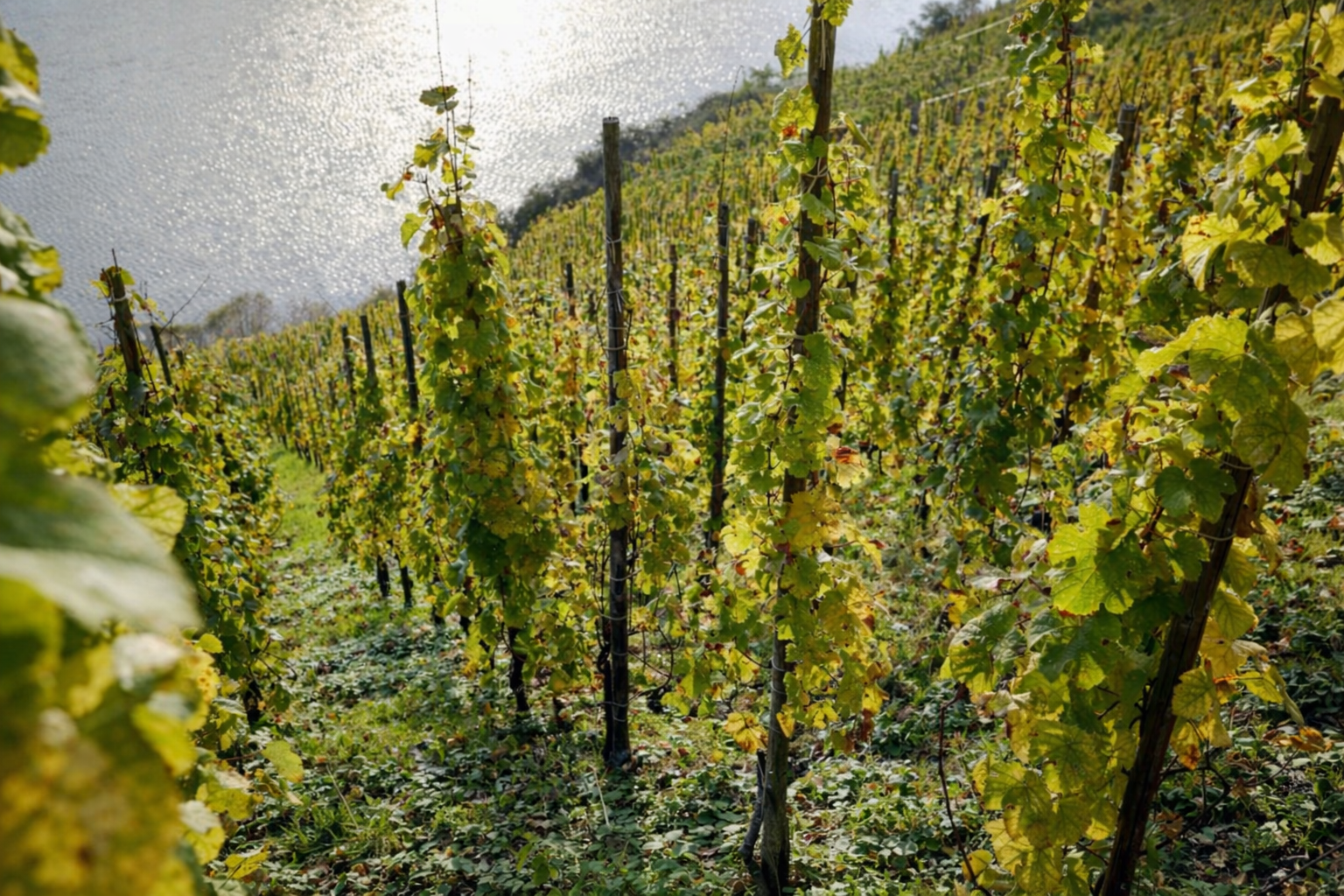
Regarding the header image of this season’s wine club: I apologize to anyone susceptible to vertigo… I didn’t have to look further than the producer’s website of this season’s Riesling bottling for a photo capturing the extreme steepness of the vineyards of the Mosel Valley in Southwestern Germany. Its namesake river, with extreme contortions and 180-degree hairpin turns, has shaped some of the steepest and most dramatic vineyards in the world, all of them infused with history and lore. You can’t throw a stone without hitting a Roman press house or an abbey founded in the Middle Ages.
Farming here is nearly impossible. Vineyards in this part of the world continue to fallow, yet it only took one bottle of late-harvest Riesling from these vineyards to turn a young Daniel Vollenweider, a Swiss guy with no family connection to winemaking, into a full-fledged fanatic. Within a few years of his 1999 purchase of his first plot of ancient ungrafted vines in the Middle Mosel, his name became a symbol of the highest quality due to his masterful sweet wines. Only recently have his dry wines gotten the attention they deserve. From spring of 2019 until his untimely death in July of 2022, Daniel privately battled stage 4 cancer. Upon his diagnosis, he began handing the reins to Moritz Hoffmann, a promising young winemaker from a nearby village, and the wines became more precise, clean, focused, and alive. They are sourced from over 100-year-old massale selection (genetically diverse) Riesling grown in impossibly steep slate soils. “Never for money, always for love” is the unofficial motto of winegrowers here, and I’m honored to be able to share the love with you.
With 3 grams per liter of residual sugar, this is a dry (trocken) style wine with plentiful acidity. Pair it with fatty foods like fried chicken, schnitzel, carnitas, or takeout from Bangers and Brews.
Raúl Pérez – Albariño “Atalier a cruz das animas” 2023
.png)
Just north of Portugal is the Spanish state of Galicia, home to a section of some of Spain’s most rugged coastline. Among the fjord-like peaks, valleys, and cliffs is a wine region called Rias Baixas, or “lower rivers,” which is a region entirely dedicated to the production of Albariño. In adjacent valleys, “old” Albariño vines are 35–40 years old, but here in the Val do Salnés, “old” has a very different meaning. The vines that produce this wine are over 150 years old, farmed by a man named Vincente who is nearly 90 years old and has farmed them his entire life. Sandy soils mean this vineyard was unaffected by the plague of phylloxera, the tiny aphid-like insect native to America that destroyed almost all of Europe’s vineyards in the late 1800’s. Planted around the start of this plague in 1860, these own-rooted vines offer a glimpse into the past, before almost all of France’s vines were grafted onto American rootstock.
Now that you know the vineyard, now you must meet the man who turns it into wine. Raúl Pérez Pereira is universally considered to be one of the world’s most visionary winemakers. Since he produced his first vintage for his family’s winery in 1994 at the age 22, he has been in the forefront of the conversation about what has been called “The New Spain.” Atelier, or workshop, is a collaborative project with Rodri Méndez, the unofficial conservationist-in-chief of the Val do Salnés. A cruz das animas (trans. “The Crossroads of Souls”) is their Albariño from this ancient vineyard. They harvest the fruit a great deal later than their neighbors, rendering the wine softer yet still explosive. Bring this to a summer potluck alongside some homemade patatas bravas.
Jolie Laide – Trousseau Gris 2024
.png)
I recently likened Oregon’s border with California to the US border with Canada: tons of amazing wine is made there, but only a few of the smaller production gems are brought across. If you like numbers: Oregon only produces 1% of US wine, but receives over 20% of Wine Spectator’s 90-point scores (if you’re into that sort of thing) and half of our vineyards are farmed sustainably (or better), so it’s safe to say we have a lot of pride here. But one of the things that’s lacking in the Oregon wine market: variety! Pinot Noir and Pinot Gris make up almost ¾ of all acreage in Oregon, and though we grow over 70 total varieties, California has over 100! This wine is made from one of the most rare varieties: Trousseau Gris.
Planted in the late 1970s, the Fanucchi Wood Road vineyard is home to these rare, near extinct vines with massive, gnarly trunks that produce unique and fascinating fruit. In return, the wine made from them is always beguilingly complex and nuanced. In 2024, Mother Nature graced Scott and Jenny Schultz with half the fruit yielded in 2023 making this Trousseau Gris as rare as the old vines that produced it. They foot-stomped the pink-skinned fruit and let it cold-soak for three days, imparting texture, rich flavor, and a roseate hue from the skins. Occupying the space between orange, white, and rose, this enigmatic wine is a formidable opponent to the heat of summer. Take it to the lake, the river, a picnic, the golf course, the badlands at sunset; your thirst doesn’t stand a chance.
Domaine La Boheme – Pinot Noir “P” 2023
.png)
France’s Auvergne region lies entirely within the Massif Central mountain range which features volcanic landscapes, including the Monts Dore and the Chaîne des Puys. Pre-phyloxera this region was an agricultural and winemaking hub of France due to fertile volcanic soils and favorable continental climate. These days it’s home to some of France’s foremost experimental and natural winemakers due to the wide variety of grapes that flourish here and this winery’s proprietor, Patrick Bouju, is one of the leaders of the pack. He first started drinking wine while he was a chemistry student in Clermont-Ferrand, and quickly realized he had a dislike for classical wine, as his body had an intolerance for sulphur. In 1994 and 1995, while joining the military in Chalon-sur-Saône, Patrick met many sons of low-intervention winemakers, inspiring him to go on to study viticulture in Beaune. He now tends to several plots of vines around his home village of Glaine-Montaigut, some dating back 120 years. Prior to this, I had only seen up to 4 bottles of any of his other wines; they are extremely limited and sought after in the niche world of natural wines. This is his volcanic-influenced Pinot Noir made entirely in stainless steel and it comes out swinging! The label says it’s 14% ABV but it certainly doesn’t drink like it. It’s also one of the wildest reds I’ve put in your 6-packs. Like the Sauvignon Blanc from last time, this one’s made with no added sulfites which means it’s alive and unstable once opened, so bring it to a backyard garden party and watch it disappear.
Day Wines – Infinite Air Castles 2021
.png)
Founder Brianne Day is one of the reasons the Oregon wine scene is cool. Back in 2017 in Dundee, she opened a communal winery space called Day Camp that welcomed budding boutique wineries and rented them a small space in her facility to make their wine and grow their brand in one of the most exciting times for Willamette Valley and Oregon wine in general. Eventually, due to the pandemic and her production out-growing her limited space, she made the space entirely hers and continues making some of the most unique wines in Oregon, sourced from organic vineyards spanning the entirety of the state. Infinite Air Castles refers to an idea, day dream, or “air castle.” It’s a blend of Gamay and Dolcetto, two grapes typically viewed as more “humble” in their home countries of France and Italy; an international party of salt-of-the-earth people. Pair with anything off the grill!
Az. Ag. Lalù – Langhe Nebbiolo 2023
.png)
Lalù stands for the combination of Lara and Luisa, two young women from Turin without any rural roots who met while studying at the University of Gastronomic Science near Bra in Piedmonte. Taking advantage of their proximity to the Langhe region’s slopes, Lara and Luisa developed their wine enthusiasm by visiting an extensive number of wine producers during their time in University. They then spent time separately working at wineries in both the Northern and Southern Hemispheres before settling in the village of La Morra in Piedmont. While working at a local cantina in 2015, they planted their first vineyard and in 2019 made their first wines as LaLú. They immediately attracted worldwide attention. Traditionally, Piedmontese winemakers use large botti, oval-shaped casks similar to foudre, but Lara and Luisa utilize concrete tanks and Burgundian barrels which are smaller and allow for more oxygen exchange. This technique shaves the rough edges off of Nebbiolo, making it smoother and more fruity and enjoyable from the start. Their Langhe Nebbiolo is made from their young vines in La Morra as well as their holdings in Monforte d’Alba. Not made for purists, it’s a wine for those looking to explore another side of the Langhe, with unique softness and beauty. Give this a rip with some hand-stuffed local trout ravioli. There are so many recipes out there, choose the one that looks best to you!
Chinati Vergano – Americano Vermouth (Optional)
Mauro Vergano spent the first 15 years of his professional life as a chemist in the “flavors and fragrances” sector. This allowed him to get very good at using certain instruments, as well as honing his nose and perfecting his blends. However, his interest in wine couldn't be ignored; it had led him to a master's in winemaking after finishing his undergrad in chemistry, afterall. His first trials making traditional Piedmontese aperatifs like Chinato and Vermouth were in the 1970’s with the aid of his pharmacist father and winemaker uncle. He made it for personal use until 2003, when he finally released his first bottles into the market, and they were instant classics. Some are extremely traditional, while others are a bit more experimental. His Americano is more of the latter. Having nothing to do with America (confusing, I know) Americano is a traditional aperitif of the Piedmont region in Italy, enjoyed for more than a century. It is made from a red wine of Grignolino, a rare indigenous varietal, blended with raw alcohol steeped in sugar, wormwood, savoury, orange skin, gentian root, and a host of dry Italian pantry herbs and includes an uncommon ingredient among the more “typical” versions: cardamom. This provides a unique depth of flavor that makes this infinitely delicious. Enjoy this neat or over ice with an orange peel.