Spring 2025 Wine Club
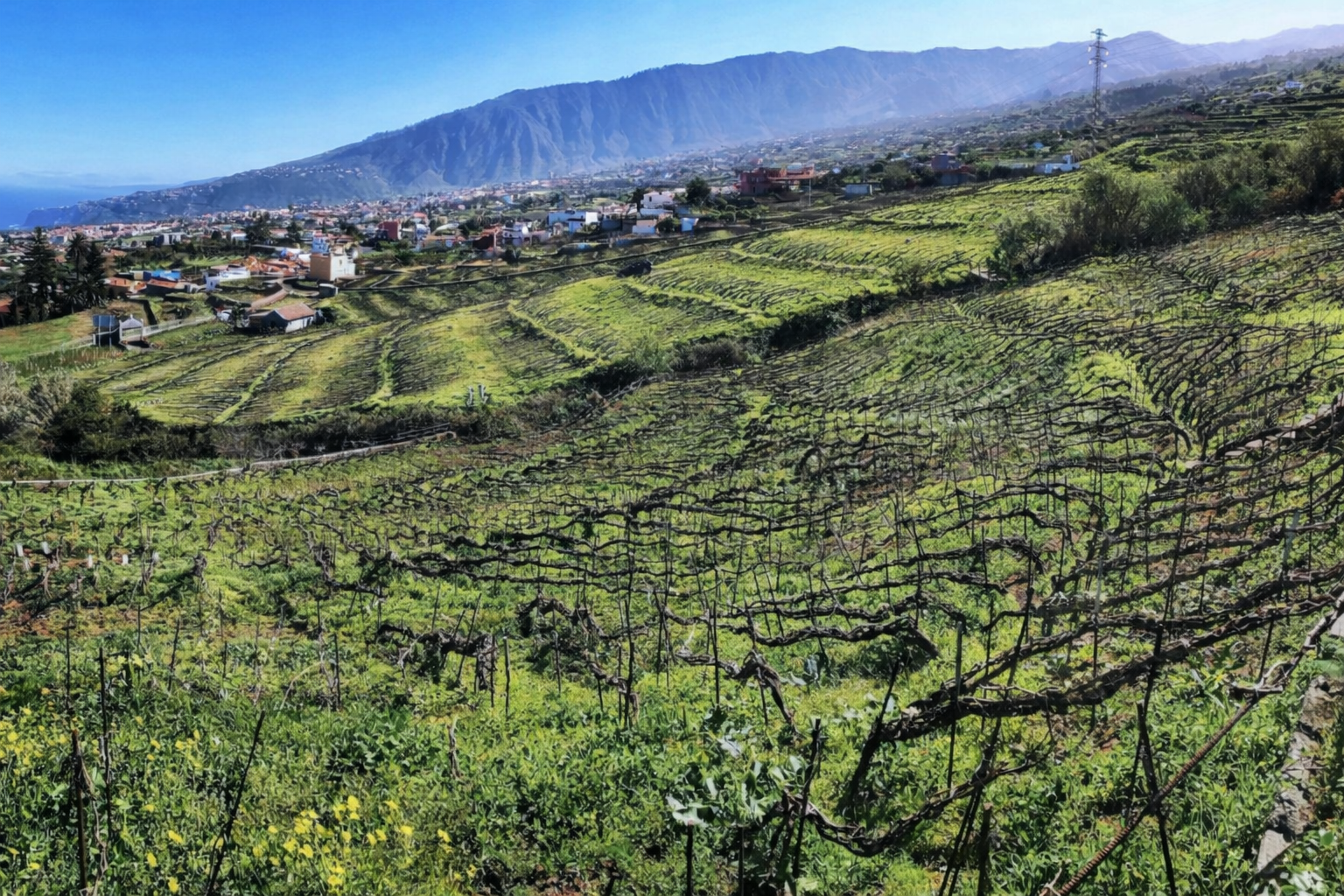
Anyone else dreaming of going someplace a bit warmer? Don’t get me wrong, these longer sunnier days are doing wonders for my mood, but we can still dream, right? Pictured above is springtime in the Valle de Orotava of Tenerife in the Canary Islands where one wine from this quarter was grown, and a bucket list destination for me. Through my research and discoveries in the world of wine, I’ve found some truly epic places that I may not have found otherwise and I’m so lucky that I’m able to go and explore them. I hope that by showing you some of these places, often tucked away from the main tourism destinations, that you’ll stray off the beaten path should you ever find yourself in their vicinity. I ultimately hope to inspire you all to take a trip somewhere foreign, far, or even forgotten in the hopes of discovering something truly amazing. “The road less traveled” and all that, right?
By visiting people in these types of places, you become more of an explorer than simply a tourist, bringing even greater enrichment. Not only do you benefit, but you also validate and reaffirm a lifetime of dedication to their local traditions and culture with your support and curiosity. Some of you have reached out for my advice on travel and, while I am not as well traveled as I’d like, I’m always available for any wine-quiries you might have. Even if you’re going to Paris or Rome and want to spend a couple days in the countryside, I am more than willing to offer my two cents.
These spring wines continue in that spirit of exploration, as they always have and always will. Of course, they are also youthful expressive wines meant to pair with the revitalization and rejuvenation of the season. They’re wines rooted in ancient tradition or modern renaissance, some both at the same time. All are made with a gentle hand in the cellar, allowing their varietal character and youthful energy to shine through, a perfect match for springtime.
Terres d’Imaginaire – Chenin Blanc ‘Feu Follet’ Vin de France 2023
.png)
This project is still in its infancy; Mathilde Magne purchased her first six and a half acres of vines in 2022 and expanded with 15 more acres in January 2023. She’s undoubtedly very young, but the pedigree of her 10 years of winegrowing and producing experience is of the highest pedigree, in my humble opinion. She studied agronomy and winemaking, having grown up in Paris with no family involved in agriculture, and then worked for some very high-caliber producers in Bordeaux and Tuscany, before settling in Burgundy with Sylvain Pataille, who might be my favorite producer in the region. She worked with him for three years, absorbing his incredible knowledge of terroir; while his farming is among the best in the world, his white wines are some of the most direct translations of the soils they’re grown in you can find. Mathilde surely uses her experience to inform her winemaking, but her project and vision is entirely her own.
Terres d’Imaginaire, or “Lands of Imagination,” is a name with a few meanings. “On one side, the earth, the base from which the raw material is produced. On the other, the imagination to leave room for creativity, freedom and the desire to experiment.” Her vines are in the Anjou noir department of the Loire Valley, farmed with the goal of producing transparent and terroir-driven wines through farming that restores the synergies between the vine and its environment. The name Feu follet is a reference to a Cajun folklore tale of floating balls of fires that appear and dance above marshes. It’s her largest production white of 100% Chenin Blanc from 8–40 year old vines grown in sandstone and schist soils. For me, there’s nothing like great Chenin such as this. The weight, texture, and complexity are engaging yet refreshing with plenty of acidity and energy. Food pairing possibilities are endless with a wine like this, so I’d rather recommend it après spring skiing or hiking with parking lot snacks of funky cheeses and cured meats.
Weingut Schnabel – Ermihof – Sauvignon Blanc “Legionarin” 2021
.png)
Austrian wines have been criminally underrepresented in the Oregon market until very recently when Dana Frank, former owner of the iconic Bar Norman, a natural wine bar in Portland, closed up shop and opened her own importing company. Called “High Five Selections,” Dana is bringing some of the most authentic and beautiful small-production wines coming out of this amazing place. This is one.
Located in South Styria, “Südsteiermark” locally, on the Austrian border with Slovenia, Karl and Eva Schnabel, along with their three sons, farm their vineyards on the slopes of the Sausal mountain range. Their farm has been in their family for generations, always farmed in harmony with nature. Karl claims he never learned to farm this way, he was born into it. Everything is done by hand, including clearing grasses under the vines by scythe. Nettle and horsetail teas are employed in the vineyards, and Karl raises six Alpine cows that are a protected Austrian breed of Celtic origin. Maya is the cow pictured on most of the labels.
They’ve been at the helm of their winery since 1998, and consider their wines “cultural goods of original tradition.” They are producing beautifully clean, lively, and natural wines “without any sulfur and other additives added as well as without any chemical and technical manipulation.” The intention here is to convey the rugged and wild terrain of the Sausal through a pure and unadulterated Sauvignon Blanc, and their wines have people talking. They make this wine two ways: one is a heavily skin-macerated orange wine, the other is a strikingly mineral and rich direct-press white wine. The one I’ve chosen for you all is the latter; I tried a bottle around Thanksgiving and it just about knocked me off of my feet. There’s just personality, texture, and body like I’ve never known in a Sauvignon Blanc. A truly beautiful wine on its own, you could also enjoy this with a skillet of slow simmered fennel, onion, bacon, and bratwurst.
Fekete Pince – Somlói Juhfark 2019
.png)
To properly frame this wine into its importance in the world, a brief history lesson is necessary. Hungary was in relations with the Soviet Union starting shortly before the 1920’s, and was formally occupied by Soviet troops from WW2 until 1991. During this time, private wineries became state controlled and, while farmers could own small pieces of land, almost all of their grape production went to a few large cooperatives, was made into homogenous bulk wine, and sold across the Soviet Union. The state even controlled what grapes were planted. Since their liberation, a cultural renaissance has been taking place – quietly at first, but it grows louder with each passing year. Winemakers & growers are constantly evolving and redefining what Hungarian wine is and can be.
Belá Fekete, pictured top right, was one of the first to put roots down outside of the traditionally more productive zones of winegrowing. He purchased his first vineyards in the 1970’s and expanded his holdings until he sold his estate to Gábor Riesz (bottom left) in 2014. Vines are planted on the highly coveted southern facing slopes of an incredibly unique formation (depicted on the wine’s label) called Somlói: an extinct underwater volcano that rises sharply off the vast and flat surrounding land that was once the sea floor. I don’t have enough room to put a photo here, but you should look it up, it’s a remarkable place. Writings about winegrowing here date back to the 11th century, with viticulture dating back to the Romans (35 BC – 271 AD) and Hungarian kings have previously owned vineyards here due to their pedigree.
Fekete Pince’s wines from these vineyards undergo extended aging of 3–4 years in the cellar, allowing them to reach peak maturity before release so you don’t have to age them yourself. This particular wine is made of Juhfark, pronounced “you-fark,” a native white grape whose name means “sheep’s tail” due to how the clusters curl at the tip. If you’re going to try one wine from this region, Fekete’s Juhfark is it; I am so excited I get to share it with you. I’m told the forest at the top of the volcano is home to wild boar and every year they harvest one for a festival, so this would make a great accompaniment to slow roasted pork shoulder with paprika.
Dolores Cabrera – “La Araucaria” Tinto 2023
.png)
Circling back to the photo in the header of this month’s newsletter: there are few places that can grow grapes as spectacular as the Canary Islands. Whether it’s the braided “cordon trenzado” vine training system used in the Valle de Orotava on Tenerife, or the deep “hoyos” (pits) dug into the black volcanic ash on Lanzarote, this place is simply spectacular. It’s believed by many that a visit to Tenerife inspired Elysium, a place in Homer’s epic The Odyssey “where the sea gives fresh life … and men live a sweet and peaceful life, without snow, harsh winters, or rain, but a perennial cool air, born of the breath of the zephyrs that the ocean exhales in a musical breath.”
It is here that Dolores Cabrera Fernández was raised and still calls home, making distinctive wines from centenarian vines of native varietals, namely Listan Negro and Listan Blanco. Her vines are the true loves of her life, and her vineyards are trained using the aforementioned traditional and completely unique “cordon trenzado” system of braiding vines close to the ground, held up by supports in order to facilitate better airflow to combat mildew due to the Atlantic humidity. Canary Island wines are divisive: grown in young volcanic soils, they can have a tendency to produce a smoky and sulfuric aroma. Some call this terroir, others think they’re undrinkable. I believe it’s the former, however this red is completely free of any volcanic aromas. Instead, there’s just pure Listan Negro varietal character, showcasing why it’s one of my favorite grapes in the world. Drink this with antipasti or grilled yellowfin tuna over braised peppers and Spanish rice.
Petit Roy – Bourgogne Rouge ‘Si’ 2022
.png)
I know we live in Oregon and have decent Pinot Noir available to us at all times, so does it really make sense to put one in club? Well, this isn’t just any Pinot. It’s a special red Burgundy that’s from more of a “if you know, you know” type of producer. Much like the Feu Follet above, a very important part of this wine is who made and how they got their start: Seiichi Saito. He’s a Japanese expat with Chinese origins who studied at the wine school in Beaune in 2006, and then moved to Burgundy in 2008 to dig deeper. Before starting Petit-Roy (little king) in 2017, Seiichi spent time working with a few brilliant domaines such as Simon Bize, Mugnier, Rousseau and Leflaive. For those not familiar with high-end Burgundy, these are some HUGE names.
In 2014, he co-launched one of the most successful (and probably tiniest) restaurants in Beaune, called La Lune, known for precision, elegance and pure umami indulgence. He began his tiny winery with just five acres of vines he farms Biodynamically and a bit of purchased fruit. “Si” Rouge is one of his purchased-fruit wines, made using 50% whole cluster organic Pinot from the commune of Comblanchien. The only reason I’m able to offer you this wine at all is because he offered it to my distributor after their initial purchase of all of his other cuvées, which were stringently allocated across the state. To be honest, I haven’t even tried one of his wines due to their rarity. I’m bringing you this wine based solely on his reputation and am excited we get to have this experience together. Don’t overthink it, though. Just drink it!!
The Color Collector – Willamette Valley Gamay Noir 2023
.png)
Winemaker Bethany Kimmel found wine in a most unlikely place: Jackson Hole. Originally from Tennessee, she worked in a small shop on Broadway for three years slowly experiencing a wine epiphany that culminated with a move to the Willamette Valley in 2011, her “ah-ha!” moment. Since then, she has worked in some of the best cellars across the state, including Soter and Analemma, as well as in California and New Zealand. In 2015, she started The Color Collector and has always worked exclusively with Gamay, seeking out old, tiny, and unique parcels to craft her breathtaking small production wines, using only a small basket press and no pumps.
She believes Gamay, known primarily from Beaujolais, is perfectly suited to the Willamette’s climate, reaching optimal ripeness for low-intervention winemaking. Hers are among some of my favorite expressions of the varietal, both beautiful and personal. Her project is named after a mouse in the children’s book Frederick by Leo Lionni that, instead of storing food for the winter, gathers tales of summer to share with friends to help sustain them. Drink this when you just need a push to get through those final cold and damp days of spring, but don’t forget to savor the moment.